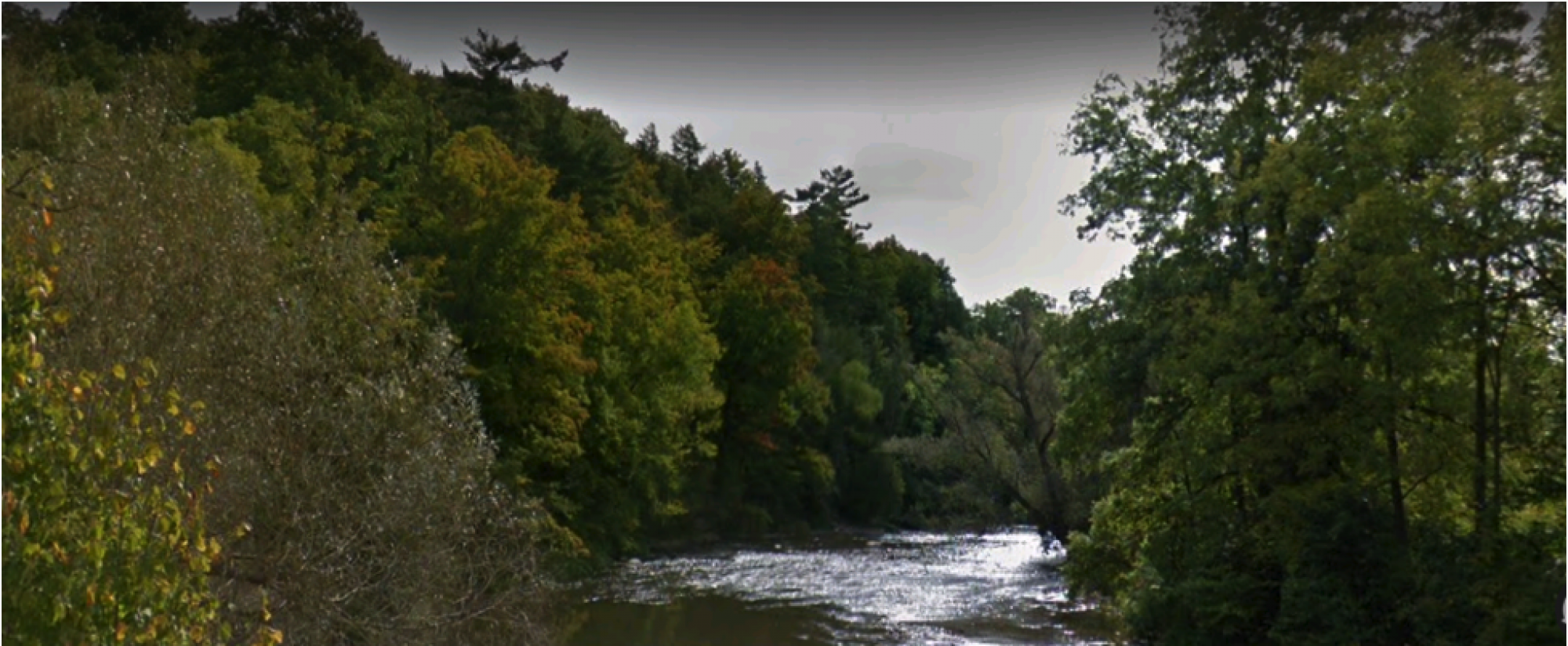
The “movie” was on television again this week. It doesn’t come on very often, and even when it does I don’t always watch it, as was the case this time. Coincidentally, I had just watched it the week before 🙂 The “movie” is how most fly fishermen refer to it, usually with a bit of mock contempt, especially those who have been fishing for many years; the actual title for those of you who do not fish is A River Runs Through It.
It is a beautiful movie, certainly one of my favourites, and most definitely planted the seed for my own entry into the sport. When I first saw it, decades ago, I was enamoured with the thought of wading into a swift current on a wild, back country mountain river, with a fly rod in hand. The artistry of the sport elevates it above that of the usual angler, such as a spin caster or (more derision) a live bait caster. It is unfair to be so snobbish when comparing the types of anglers, but there is no argument that fly fishing takes much more skill than the other two aforementioned methods.
Spin casting consists of casting a lure (spoon, plug etc.), usually with a treble hook, into a pool and retrieving it with some action to mimic the movements of a small fish, or another aquatic creature. This certainly takes skill, but even the most basic retrieves impart motion due to the design of the lure, so it isn’t difficult to master. Bait fishing requires you to put bait (worm, minnow etc.) on a hook and cast it into a pool, and wait. This isn’t so much a skill set as it is an exercise in patience. While both of these methods are a good means of clearing your mind, there is the definite goal of catching fish associated with them, and they are not practised by “catch and release” anglers.
Fly fishing is a different game altogether. It is no hyperbole to describe it as “the art of fly fishing”. On the most rudimentary level, you have to have a combination of precise timing in your casting motion, unerring accuracy in the target, and a perfect, exquisite presentation of your fly, which is tied on a barbless hook and most times is smaller than the tip of a pencil, to mimic the natural motion of a mayfly landing on the water. Then, you have to manage your fly line against the swirling waters and currents to ensure it appears natural; any drag in the line condemns the process to failure. Do it all perfectly, and you have about ten seconds at best before it looks unnatural and you start all over again. Ten seconds at best, compared to a minute or more for a spin caster, and perhaps an hour for a bait fisherman. And, this is at the most rudimentary, basic level.
I take a more stylized, artistic approach to my casting. Instead of the basic four count, regimented range of motion, I prefer an open casting approach with tantalizing false casts, presenting my fly a few times across the water, mere inches above the river, then dropping it gently into position, sometimes in an area no more than a couple of feet wide, often obscured by overhanging and/or fallen trees. Done right it produces an instant strike and yes, the objective of all of this is to catch a fish; that provides reassurance that you are doing things right, but once caught, in a completely antithetical action, I gently remove the hook and release my catch, because that’s not why I do it.
I do it for the challenge, I do it for the quest. I do it for the adventure, the travels and the experience. I do it for exercise and the fresh air, for the chance to be outside standing in pristine waters. I do it for my health, both physical and mental, and my mental health needs some attention right now. Nothing critical, I just have to rebalance things.
That’s why I’m going to go out again this year, going to venture out to some major river systems in winter, maybe the Maitland, or the Saugeen, or both. I’m going to stand in water that’s barely above freezing, in air that is below freezing, chasing the speedy, powerful steelheads, with slim to no chance of catching anything.
If nothing else it’ll be like a winter walk through the forest, an immersive version of sitting by the window in a snowstorm. I’ll be warm enough; I’ve got the proper gear to keep out the cold and stay dry, even in the middle of the river in winter. It will be therapeutic, restorative and reflective. And by doing this, I’ll make myself well again.
It is most definitely not about the fish.
 Come Fly With Me