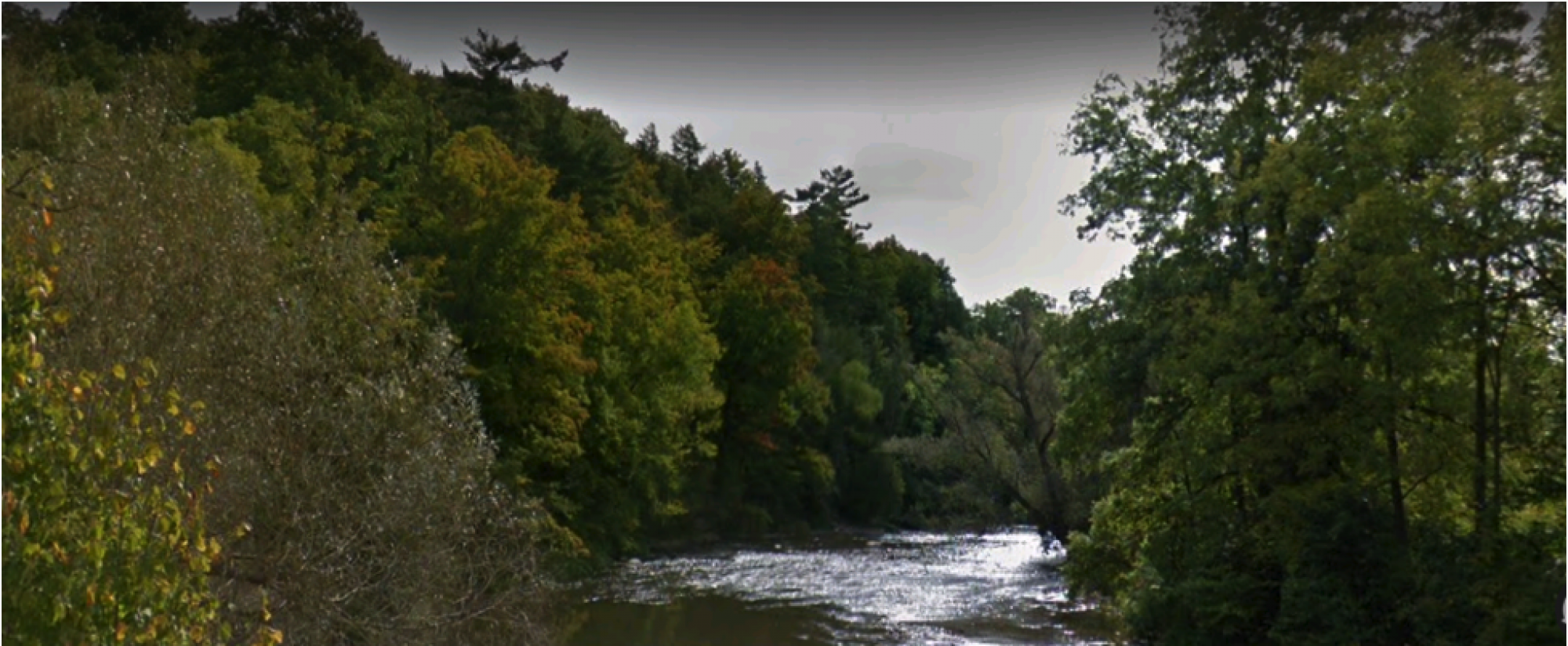
A few days ago I ventured out to one of the last spots on the Credit that were still in season. Realistically, the year is over for brook or brown trout, but for the next couple of weeks there is still opportunity to go out for steelhead (migratory rainbow trout), so even though I’m not really motivated by this, the day was beautiful so I took advantage of it to get one last day in this year.
I packed up my cold weather gear, because it was October, after all, and headed to a local conservation area. After gearing up, I set off through the brush to the river, a distance of about 150 metres. I had only been walking a few minutes when I realized that I was in for quite a trek. The undergrowth of the woods was about 6 feet high, except in the occasional area that was a bit beaten down, but even there it was an effort to get through. The long grass that had curled over the barely discernible path had the effect of multiple snares, set at every step, making passage quite difficult. On top of this, my cold weather gear is much heavier than my normal outfitting, with heavier waders, under clothing and outer ware.
However, if I let this put me off fishing then I couldn’t lay claim to being a fisherman. Great effort will reap great reward, or so I said, hoping the effort didn’t kill me first, so I made myself labour on, making slow progress. Finally I arrived at the riverbank, only to find that the river was inaccessible due to a long marsh that didn’t provide safe footing, so I had to retrace my steps and work upstream another 100 metres until I found a safe access point.
The first order of business was to refit myself, so I re-rigged my gear to ensure I could comfortably spend the next few hours on the water. I then took stock of the area and set up my tackle accordingly, and began my day’s efforts.
I had only been fishing for about ten minutes when there was a large commotion a few feet away from me, in a rapid but shallower area of the river. I turned to watch a very large salmon thrashing its way upstream, on its own quest. It was trying to get upstream to spawn.
I ignored it, and moved upstream of it to fish in a different area of the river, leaving it to continue on. However, after a few more minutes I noticed a few other salmon, all intent on getting upstream to the spawning area. This gave me pause to think.
When I chose my fly to begin fishing, I chose a larger streamer that I had tied the night before with the intent of attracting the larger brown trout that tend to linger in this area through October. Streamer fishing emulates the actions of smaller bait fish, and tend to invoke savage strikes from these large trout as they fatten up for the winter. They also can produce strikes from spawning fish but these strikes are more out of anger, as the fly resembles smaller fish that will eat their eggs. I didn’t want that to happen, so I moved further upstream.
As I walked the river, I noticed even more salmon; when I stopped in a nice area mid river, some of them swam within two feet of me. These were huge fish, approximately 30 inches long and probably close to 30 lbs or larger. I could have likely invoked a strike from one of them, just by dropping my cast a few feet in front of it and stripping past it quickly. I know that I could land it quickly too, because it had already spent most of its energy in its journey upstream. I could even see where they were so it would be easy to target them too.
With all this in mind, I cut off the fly I had rigged, extended my leader with a 2 1/2 lb test tippet, and replaced the fly with a size 20 midge. For reference, if you’re familiar with the mints Tic Tacs, a size 20 hook is about 3/4 the size of a Tic Tac. This set up was so small that the salmon wouldn’t even notice it, and it was so light that even if I accidentally hit one of them and snagged it, the line would break at the slightest resistance.
I then began casting into the more difficult areas of the river; close to the bank, behind overgrowth and under low hanging bushes and trees. I knew that there would be no salmon in these areas, if fact at this time of year I don’t think there would be any fish in those areas, so this was really just practice. I carried on for a short time and then decided to call it a day. I had been fishing for less than an hour.
As a fly fisherman, I would love to entice a 30 inch, 30 lb fish to take my fly. Fighting and landing such a fish is every angler’s dream. In their prime, earlier in the season, one of these fish would provide me with the fight of my life, for 30 minutes or more, with no guarantee of a successful outcome, but taking one of these fish on this day would be the last thing any fisherman wants. These huge fish were acting out the last act of their lives. They had no fight in them save the instinct that drove them toward their destiny. They had exhausted themselves in their quest to perform their final purpose in life, and for me to take advantage of the situation and defeat their purpose would be unconscionable. So I just stood there for a while, watching them go by.
Finally, it was time to officially call it a season. I had some success, not as much as before, but that’s all part of the game. I know that next year, the river will still be here for me, and we can try this again. Until then.
 Come Fly With Me