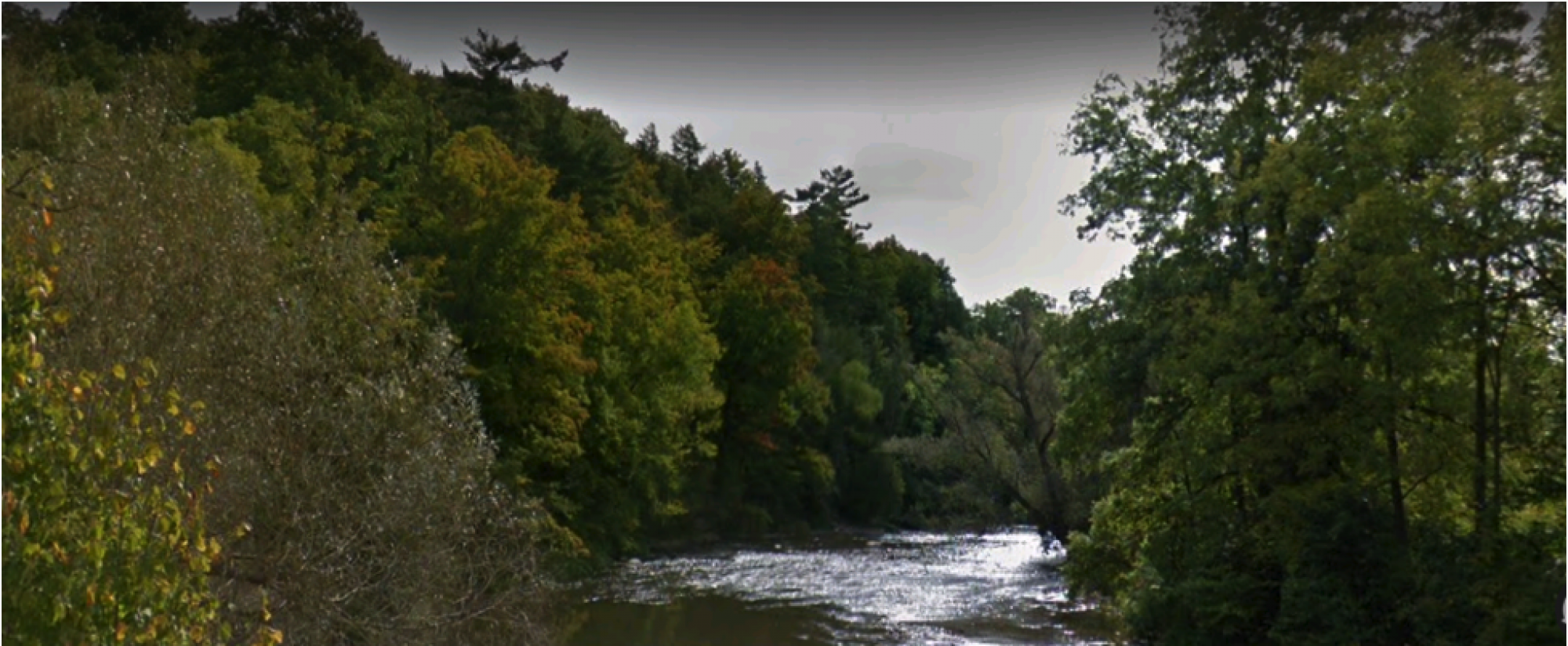
Tonight I grabbed an opportunity for a quick trip to the Credit. I know things are going to be busy for the next little while, and I may not get many chances to get out and fish for a while, so when I found myself with a few hours I seized the day!
A little Walter Becker and Donald Fagen got me on my way.
I knew I didn’t have a lot of time, so I headed to a location that I had scouted a few times in the spring. Back then, the waters were angry and swollen with spring run off, but I was hoping that tonight, even though we’d had some rain, there would be a chance to wet a line.
When I got there I was encouraged as the river levels were normal. Normal waters for the Credit river are challenging enough, as this river is fast and strong, (I’ve previously described it as a monster, I was being kind) but that is the attraction. That and the resident brook and brown trout that live there.
I geared up and got right to it, walking upstream to a location that I knew would keep me occupied for a few hours trying out the fast water, riffles, beds and pools. Wading out to the edge of a gravel bed, I positioned myself so that I could access several different types of water and began to get to work.
I started by casting out to the feeding seams that were flowing into a deeper channel, and I played the area for about 30 minutes and was thinking of moving upstream a bit when a nice sized brown trout hit my damselfly hard. It headed towards the opposite bank where there was some overhang, but I lifted my rod and steered it back into the open waters of the channel. It fought bravely, but about ten minutes later it was in the net. Nice brown trout on the books 🙂
I repaired my line a little and got back at it. I had been fishing a damselfly on a free run tippet with a prince nymph wet dropper (wow, I’m picking up the jargon!). Let me explain. This set up involves tying tippet to the leader, then stringing the fly loosely on the tippet (don’t tie it), and tying another piece of tippet to the first one. Then on the second piece of tippet you tie on your dropper fly. This setup allows the dropper fly to sink to a variable depth, and your first fly (loose on the tippet) can adjust and stay afloat on the top of the water. It is tricky to cast, and if you’re not careful you’ll tangle (I did) but it is an effective technique.
After my first fish, I was getting strikes from other fish but couldn’t set the hook, and then another fish hit the dropper hard. I set the hook, but this time the fish won, and it broke the line after a minute, disappearing with my prince nymph! I only caught a glimpse of the fish and it didn’t look that big, so it may have been able to get below a sunken log or something. Whatever it did, the score was now even. Game on.
I restrung the damselfly as a solo act now, rather than re-rig another dropper, and went back to work. A few more strikes without a hook set followed, but after 10 minutes number two was on the line. Another brown, this one was slightly smaller than the first.
By this time the damselfly was a little worse for wear, and I decided to switch it up completely and throw on a caddis fly. I worked up and down the channel, able to cast to several promising spots from my location on the gravel bed. It seemed that the caddis wasn’t provoking anything from the fish, but I kept the faith and played the channel up and down anyway.
At this point I took stock of the scene. I was standing thigh deep in a river with an extremely fast current, fishing a variety of areas each requiring different techniques and presentations. I had a lot of room so I could shadow cast and work out to areas in small hopping advances, could hit a channel and dead drift, and could even strip across the stream at the head of some riffles. Night was falling, fish were rising, and I was in one of the best trout streams in North America. This is the exact thing I was looking for when I started fly fishing. I had arrived.
Then, while I was revelling in the moment, another little brown trout interrupted my reverie and hit my caddis fly. This one was the smallest of the three, and as I let him go I took another look around at the place, just to close the moment that was so abruptly interrupted by the very object that drew me to the place. It was another great outing, but now it was time to go home.
As I started towards home, my local jazz station was honouring the memory of Dr. John. A fitting ending to such a night.
 Come Fly With Me